
An Introduction to Voguing
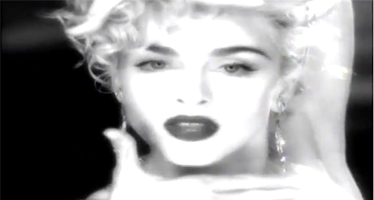
I have always been vaguely aware of the concept of vouuing; I understood that it had something to do with being ostentatious. I knew that were some distinct architectural movements involved, particularly with hands, building and constructing shapes around the face. When the word was uttered, images of Madonnas face and her gap toothed mouth, always slightly agape, flashed through my mind, along with her Jean Paul Gaultier bustier the bustier I know, is where I am confusing my references.
During the summer while I was in Melbourne, a friend of mine suggested that I watch the documentary "Paris is Burning" by Jenny Livingstone, briefly mentioning that it was a film about the origins of voguing. After watching a excerpt of the documentary on You Tube, I went on a voguing rampage. I was wikipedia-ing, I was google-ing, I was Youtube-ing for a good five hours. My suspicions were correct about voguing: it is an extremely flamboyant style of dancing named after the influential eponymous fashion magazine made famous by a smash hit Madonna made in 1990.
But voguing was and still is so much more: it is just a tiny tip of a huge cultural-racial-identity-consumerism iceberg that I wasnt expecting to encounter.
I was so fascinated by voguing that when I was offered to write an article on the subject in any style, I leapt at the opportunity. Although I will be mentioning techniques of the art of Voguing, the bulk of my article will lie in what Voguing represented to the ball world.
What is Voguing?
Voguing began in the 60s in the form of a non-aggressive battle between two individuals. Back then, voguing was known as "Performance" and was more true to its break dancing roots - movements that involved acrobatics, freeze frame poses and more "in your face" actions. Dancers who partook in "Performance" were concerned with creating symmetrical and fluid actions. It was only in the late 70s, when dancers began to emulate poses and borrow ideas from fashion editorials that the form of dance was named "Voguing", after the eponymous fashion magazine, Vogue. The style slowly started to develop feminine leanings - cat-walking, pronounced hip movements, classic striptease gestures and freeze frame poses that were inspired from supermodels began to creep into the language of Voguing. By the 90s Voguing had branched off into a new school of techniques that required excellent physical flexibility. Characteristics of this "New Way" of Voguing included rigid geometric movements and limb contortions. Pantomiming objects such as boxes and make-up compact mirrors were all part of embellishment for this new wave of Voguing.
But who introduced this highly competitive, incredibly physical and ironically anti-contact form of dancing? Voguing was birthed from the Latin and African American homosexual society that ruled the Ballroom scene of Harlem for the last three decades of the 20th century. For this community, Voguing provided almost a haven, a world for the gay, transsexuals and transvestites to express their true inner identities.
Paris is Burning
It is impossible not to mention Paris is Burning when discussing Voguing. Yes, it is a film that documented the golden age of the ballroom scene in New York City. Yes, it is a film that exposed the underground world of gay Latin and African Americans. I would not say that Paris is Burning is a film necessarily dedicated to Voguing – I believe that the films focus point lies in recoding the meanings of race and class through representation of gender. But for me, the documentary is crucial in proving that the art of Voguing is not merely to do with elaborate stylised dance moves, but as a form of art that has become a vehicle for escapism from society and ones identity.
But let me back track a little. As formentioned, Voguing evolved from break dancing into something gradually more feminine. This resulted in the “strike the pose” style of Voguing, which began in the ballrooms of Harlem, where drag queens vogued on the “catwalk” to win or compete in a ball. When drag queens did the “walk”, they were not only judged by their technique and finesse when they “walked”, but they were also scrutinised for their “realness” and their accuracy in imitating a woman or a supermodel. For many gays, transsexuals and transvestites, Voguing was a way to express their true inner selves. Dorian Corey was one of the most prominent members of the ball scene who allegedly developed Voguing into what it is now recognised by the mainstream. In an interview, Corey once mentioned the reason why he and the members of the ball world chose to participate in ball competitions: “We want to perform in front of our peers...people who understood our lifestyle”. What I understood from his statement was that being involved in the rituals of this scene - by getting dressed and emulating feminity, Voguing was almost like speaking in a secret language of an elusive and fragile world, an utopia that was made of the dream an hope of being united with ones true identity.
Paris is Burning was filmed and directed by Jennie Livingston. It was took seven years to make and was released in 1990. Immediately, the film received many awards and much praise by press and critics - New York magazine hailed Paris is Burning as “the most influential cultural works to emerge from New York City in the past 40 years”. Livingston continued making documentaries and even released a few short films, but truth be said, her success and stardom lay in the “Paris is Burning” documentary.
The success of the 2 White Women
Something I found particularly interesting about Voguing is that it was made mainstream by Madonna and to some extent, Livingston, despite the fact that the dance was initially introduced by the gay Latin and African American community of the Ball scene. Voguing propelled these two white women to stardom and success while reputable drag queens such as Dorian Corey, Luis Xtravananza and Octavia St Laurent continued their daily struggle to support themselves financially as well as exist between the glamorous ball world and being on the margin of a race which was already marginalised from American society.
Madonna first discovered Voguing while she was frequenting the Sound Factory, one of the most famous and biggest ballrooms during the 80s and 90s. She was inspired by the greatest members of the time, Luis Xtravanganza who introduced Voguing to the singer. Madonna released her single, Vogue, in March 1990 and soon it became one of her biggest hits, selling over six million copies worldwide.
The texten continues after the clip
Before Paris is Burning, Jennie Livingston initially did not specialise in film – she graduated from Yale with a minor in English Literature. However, after the success of her documentary she was nominated for several awards and was recognised as a respected and important director, and she too was propelled to stardom.
For me it is extremely ironic that a white woman gave the members of the ball world a public voice - Livingston was able to expose the world of the ball culture and Voguing because of her cultural and social standings. Having the position as a white educated woman in American society, she was able to receive the appropriate funding to launch her film successfully.
And likewise, with Madonna – her status as an international pop sensation allowed her to convert Voguing into excess commercialism and market it to the masses. She demonstrated the Balls invisibility and its inability to claim Voguing as its own.
Voguing in Pop Culture
Since Voguing became mainstream in the 90s, its purpose and significance began to change. Previously, Voguing was a language that was only uttered in the ball world But after the release of Paris is Burning and Madonnas single Vogue, the masses fell under the spell of this unique dance art. From observing various videos, I believe that many modern entertainers were highly influenced by Voguing. Take Michael Jackson for example: not only did his idiosyncratic fluid hand and feet gestures reflect the Voguing aesthetic, but his dance techniques, specifically “tutting” as seen in his Remember the Time video clip were direct references from the New Way of Vogue. And who could possibly forget the the dance-off scene in American comedy Zoolander – a perfect example ...or should I say a parody? of Voguing: two flamboyant characters living in a make-believe fantastical world, contesting each other with non-contact battle dance moves and elaborate footwork.
Voguing in Art
Voguing has been even extended to a form of visual art. New Orleans video artist Rashaad Newsome created his own personal homage to Voguing through his work “Untitled” and “Untitled – New Way”, which was revealed at Whitney Museum of American Art in 2010. Newsomes filmed various dancers tirelessly Voguing in a stark white room with no music. The effect that is achieved is the amplification of the sound of the dancers vigorous gestures; the lack of music makes the Voguers dance moves almost abstract. When I first saw the video, the silence of the film was a way of detaching the dance from any sort of reference to sound for me, it was a reference to Madonnas Vogue. The lack of surroundings, the white walls emphasised the unimportance of visuals, which for me was a counterpoint to Livingstons visual insight into the ball world. Stripping sound and vision only forces the audience to focus on one thing – the Voguer, who is forever attempting to express himself, even once the music has stopped.
Av  Doreen Ooi 17 mar 2011 11:05 Doreen Ooi 17 mar 2011 11:05 |

Författare:
Doreen Ooi
Publicerad: 17 mar 2011 11:05
Ingen faktatext angiven föreslå
Kultur, &, Nöje, Dans, Kultur & Nöje, Dans, an, introduction, to, voguing, voguing, was, and, still, is, so, much, more, than, an, extremely, flamboyant, style, of, dancing, it, is, just, a, tiny, tip, of, a, huge, culturalracialidentityconsumerism, iceberg, that, wasnt, expecting, to, encounter | föreslå
 Artikeln är inte placerad. föreslå